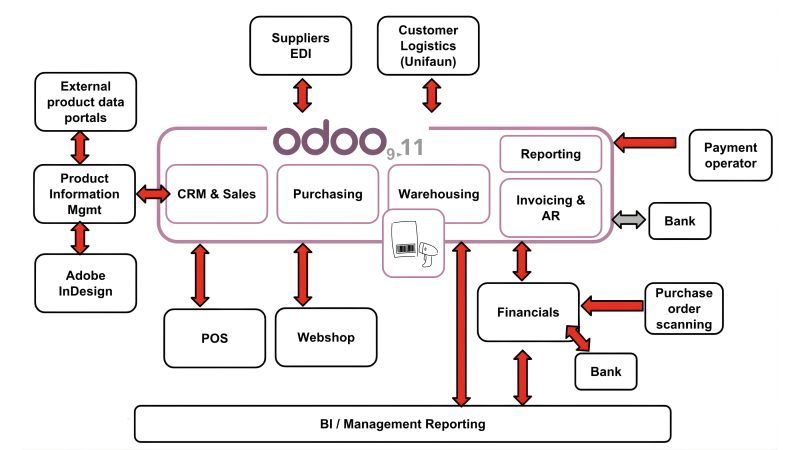
Odoo an ERP with one single platform instead of multiple Integrations

Arsalan Yasinng Project Support | Trusted Odoo Consultant for Overflow & Critical ERP Project
95% of companies think they’ve “implemented” an ERP.
Only 5% actually integrate their business.
A few years ago, I walked into a company that believed their tech stack was “solid”.
They had CRM in one place, warehousing in another, finance in a third, product data somewhere else, and BI scattered across a dozen dashboards.
Everyone insisted the system worked.
But something felt off.
Sales reps were chasing product data the marketing team had already updated.
Warehouse teams were manually fixing purchase orders that should’ve synced automatically.
Finance was reconciling numbers that never matched the system.
And leadership was making decisions based on outdated, inconsistent reports.
They weren’t lacking software.
They were lacking connection.
Then I mapped their architecture.
What I found looked almost exactly like the diagram below:
multiple tools, multiple databases, multiple sources of truth…
But none of them truly talking to each other.
When I rebuilt it around a single integrated Odoo core...
CRM, sales, purchasing, warehousing, product information, finance, EDI, logistics, payment operators, BI – everything changed.
Not because of a new system.
But because the system finally worked as one.
Sales stopped guessing.
Warehousing stopped firefighting.
Finance stopped patching holes.
Leadership finally saw the full picture.
Here’s the uncomfortable truth:
A business doesn’t scale through software.
It scales through synchronization.
Most companies bleed time, money, accuracy, and trust not because their tools are bad… but because their tools aren’t connected.
If your ERP ecosystem looks like scattered islands, you don’t need another app.
You need alignment.
And the moment you integrate, you don’t just fix operations.
You unlock your entire company’s potential.