Some Useful
Comparisons

Here are some useful Comparisons .
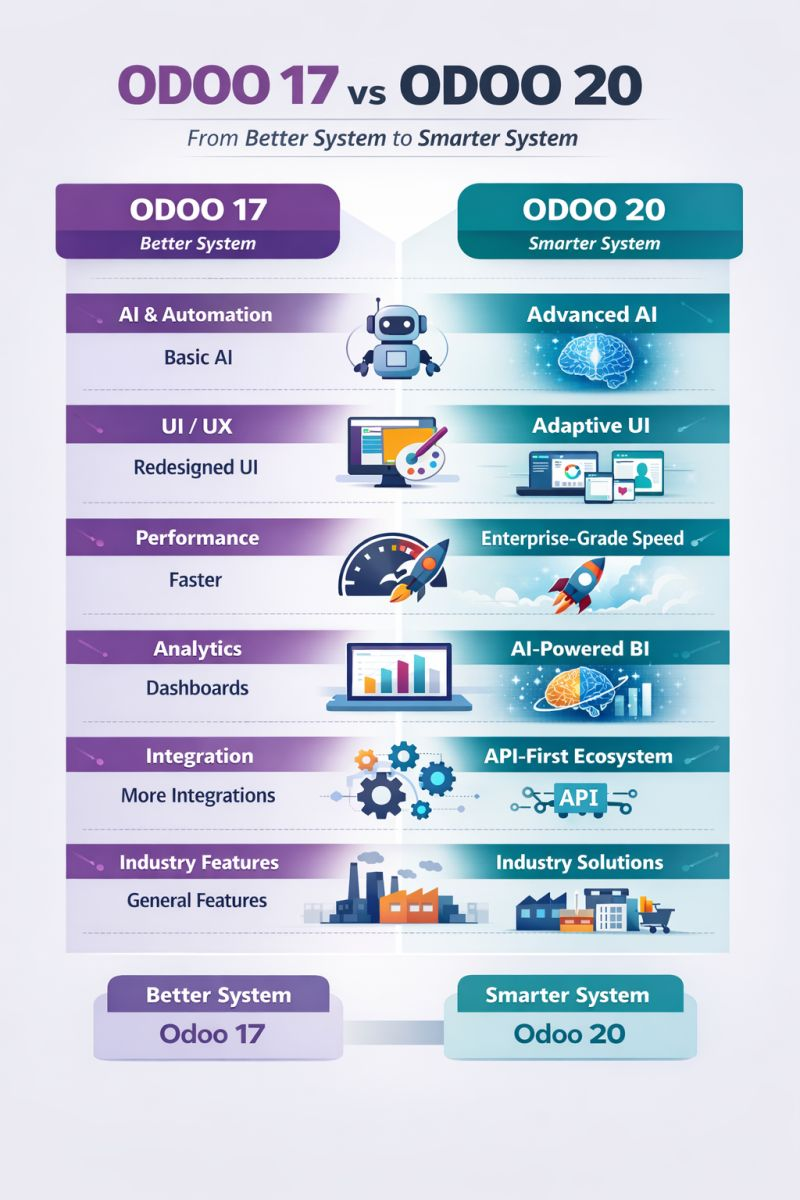
👌since **Odoo 20** is a big leap compared to **Odoo 17**.
I’ll break it down **clearly (business-focused)** so you can use it in discussions or presentations 👇
# 🔥 Key Improvements: Odoo 20 vs Odoo 17
1) 🤖 AI & Automation (Biggest Leap)
**Odoo 17:**
* Basic AI (suggestions, automation rules) ([Odoo][1])
**Odoo 20:**
* Full **AI-powered workflows**
* Smart data entry (auto-fill invoices, CRM notes)
* AI-generated emails, reports, forecasts
* Predictive analytics (sales, inventory)
👉 **Impact:**
Less manual work + smarter decisions (this is the biggest upgrade)
2) 🎨 UI/UX Evolution (From Redesign → Intelligence)
**Odoo 17:**
* Completely redesigned UI
* Better navigation & responsiveness
**Odoo 20:**
* Context-aware interface (shows what you need dynamically)
* Faster actions (fewer clicks than 17)
* Personalized dashboards per user role
👉 **Impact:**
Faster user adoption + higher productivity
3) ⚡ Performance & Scalability
**Odoo 17:**
* Faster than previous versions (~20% improvement)
**Odoo 20:**
* Even faster backend (optimized ORM & caching)
* Better handling of **large databases & multi-company setups**
* Improved cloud performance
👉 **Impact:**
Better for **growing companies / enterprises**
4) 📊 Advanced Analytics & BI
**Odoo 17:**
* Dashboards + basic analytics + charts
**Odoo 20:**
* Embedded BI (near Power BI level inside Odoo)
* Real-time KPIs across modules
* AI-driven insights (e.g., “why sales dropped”)
👉 **Impact:**
From reporting → **decision intelligence**
5) 🔗 Integration & Ecosystem
**Odoo 17:**
* More integrations than older versions
**Odoo 20:**
* API-first architecture
* Easier integration with:
* Payment gateways
* Logistics providers
* External ERPs (SAP, QuickBooks, etc.)
* Better webhook & automation tools
👉 **Impact:**
Perfect for **system integration projects (very relevant in Egypt market)**
6) 🏭 Industry-Specific Enhancements
**Odoo 17:**
* Generic improvements across modules
**Odoo 20:**
* Strong vertical solutions:
* Manufacturing (MRP automation)
* Retail (POS + omnichannel)
* Services (project profitability tracking)
* Pre-configured industry templates
👉 **Impact:**
Less customization → faster implementation
7) 📱 Mobile & User Experience
**Odoo 17:**
* Improved mobile usability
**Odoo 20:**
* Near full-feature mobile apps
* Offline capabilities improved
* Better UI for field teams
👉 **Impact:**
Stronger for **sales teams & operations on the go**
🧠 Bottom Line
* **Odoo 17 = Major UI + performance upgrade**
* **Odoo 20 = Intelligence + automation + scalability upgrade**
👉 If you’re positioning it in business terms:
* **17 = Better system**
* **20 = Smarter system**
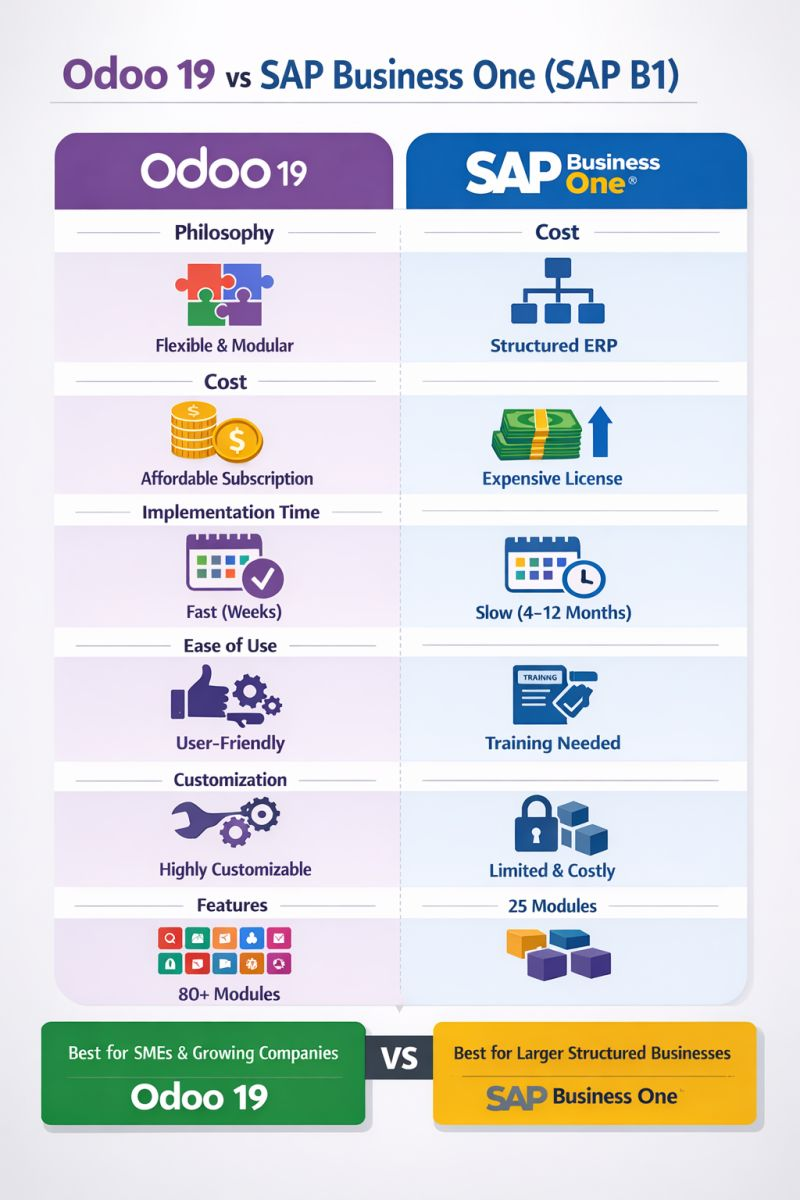
# ⚔️ Odoo 19 vs SAP Business One (SAP B1)
🧠 1. Philosophy & Architecture
**Odoo 19** follows a **modular, all-in-one platform approach, allowing businesses to start small and scale gradually by adding apps as needed.
**SAP Business One**, on the other hand, follows a more **structured and traditional ERP architecture, designed around standardized business processes.
👉 **Key Insight:**
Odoo is highly flexible and adaptable, while SAP B1 enforces structure and standardization.
💰 2. Cost
**subscription-based pricing model**, making it accessible for SMEs.
* **SAP B1** requires a higher upfront investment plus ongoing maintenance costs.
👉 **Key Insight:**
SAP B1 can cost significantly more—sometimes multiple times the cost of Odoo.
⚙️ 3. Implementation Time
* **Odoo 19:** Typically implemented in **weeks to a few months**
* **SAP B1:** Can take **4 to 12 months** depending on complexity
👉 **Key Insight:**
Odoo is faster to deploy, making it ideal for companies that need quick wins.
👨💻 4. Ease of Use
* **Odoo 19:** Modern, intuitive, and user-friendly interface
* **SAP B1:** More traditional UI, often requiring formal training
👉 **Key Insight:**
Odoo offers a smoother user experience with less onboarding effort.
🔧 5. Customization & Flexibility
* **Odoo 19:** Highly customizable using Python and modular extensions
* **SAP B1:** Customization is possible but often complex and costly
👉 **Key Insight:**
**Odoo adapts to your business**
**SAP B1 requires your business to adapt to it*
📦 6. Features & Modules
* **Odoo 19:**
* 80+ official modules
* Thousands of third-party apps
* Covers CRM, Sales, Accounting, HR, Inventory, eCommerce, and more
* **SAP B1:**
* Strong core modules (Finance, Inventory, Procurement)
* More limited ecosystem compared to Odoo
👉 **Key Insight:**
Odoo provides a broader and more integrated ecosystem in a single platform.
📈 7. Scalability & Target Market
* **Odoo 19:** Best suited for **SMEs and fast-growing companies**
* **SAP B1:** Designed for **SMEs with more structured and stable operations**
👉 **Key Insight:**
Odoo supports flexible growth, while SAP B1 supports structured scaling.
🧾 8. Financial Strength & Compliance
* **Odoo 19:** Strong accounting capabilities, suitable for most businesses
* **SAP B1:** Superior in financial control, auditing, and global compliance
👉 **Key Insight:**
SAP B1 excels in financial governance and regulatory compliance.
# 🏁 Final Verdict
## ✅ Choose **Odoo 19** if:
* You are a small to mid-sized or growing business
* You need flexibility and fast implementation
* You have a limited or moderate budget
* You want to customize the system to fit your operations
## ✅ Choose **SAP Business One** if:
* You are a more structured or larger SME
* You require strong financial governance and compliance
* You have a higher budget
* Your processes are stable and don’t require frequent customization٠
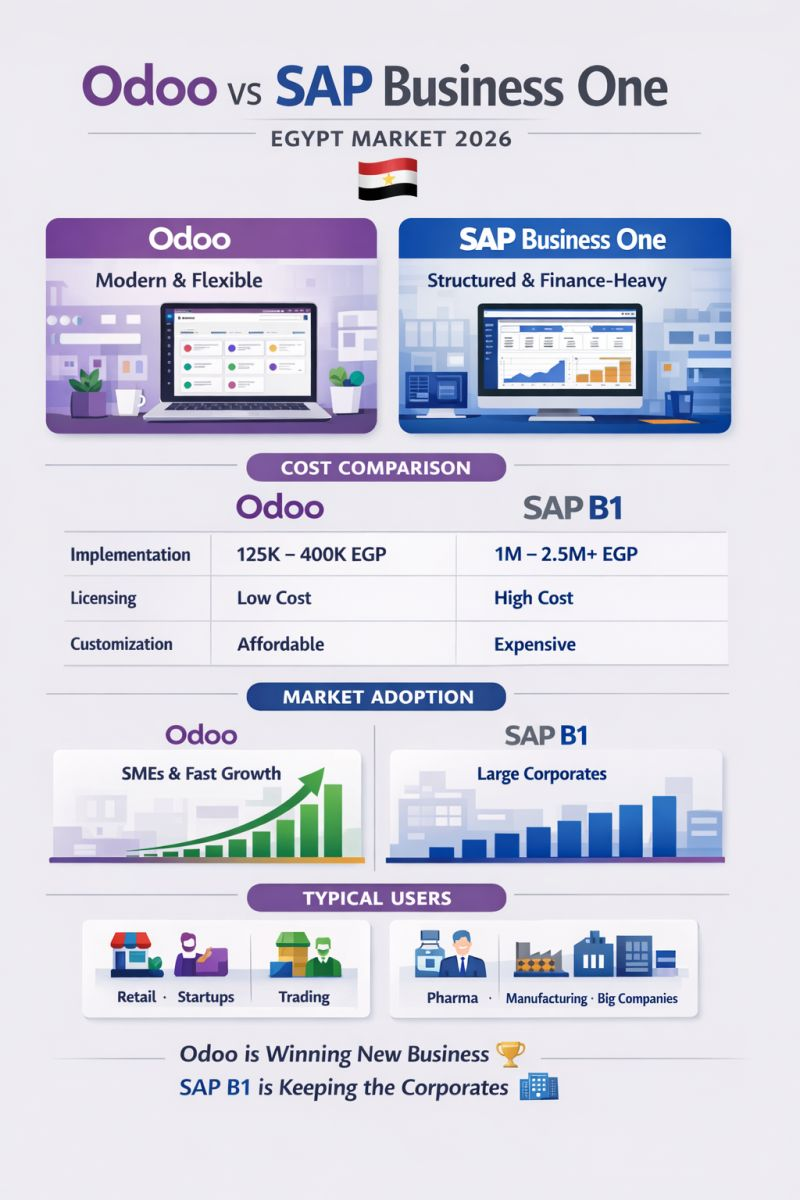
Here’s a **realistic, market-focused comparison of Odoo vs SAP Business One in Egypt (2026)** — not just features, but what’s *actually happening on the ground* 👇
# 🇪🇬 Odoo vs SAP B1 — Market Perspective in Egypt
🟢 1. Market Presence & Adoption
### 📊 Reality in Egypt:
* **Odoo**
* Dominating **SME market**
* Huge partner ecosystem (170+ partners in Egypt)
* Widely used in:
* Trading
* Manufacturing
* Distribution
* Startups
* **SAP Business One**
* Strong in:
* Large SMEs
* Corporate / structured companies
* Preferred by:
* Multinationals
* Companies with strict financial governance
👉 Globally:
* SAP B1 still slightly ahead in ERP mindshare (2.8% vs 2.3%) ([PeerSpot][2])
* But Odoo is growing fast and catching up
💰 2. Cost Positioning (BIGGEST Differentiator in Egypt)
### 💸 Odoo
* Low entry cost
* Flexible licensing (~450 EGP/user/month) ([Buildn Tech][1])
* Implementation: affordable
### 💸 SAP B1
* High upfront cost
* Implementation:
👉 **1M – 2.5M EGP minimum**
👉 In Egypt:
> 💥 **Cost alone makes Odoo win ~70% of deals in SMEs**
🧠 3. Buyer Behavior in Egypt
### 🟢 Odoo Buyers:
* Price-sensitive companies
* Fast-growing businesses
* Want **quick implementation + flexibility**
### 🔵 SAP B1 Buyers:
* Finance-driven companies
* Audit-heavy industries
* Prefer **structured processes over flexibility**
👉 Odoo = **“Business-friendly ERP”**
👉 SAP = **“Finance-first ERP”**
🚀 4. Growth Trend in Egypt
### 📈 Odoo
* Fastest growing ERP in Egypt
* Strong adoption due to:
* Arabic support
* ETA e-invoicing readiness
* Local partners
👉 Considered **#1 choice for new implementations**
### 📉 SAP B1
* Stable but slower growth
* Losing some SME deals to Odoo
* Still strong in:
* Existing SAP customers
* Large organizations
🏭 5. Industry Split (Egypt Reality)
### Odoo dominates:
* Retail & Distribution
* Light Manufacturing
* E-commerce
* Service companies
### SAP B1 dominates:
* Pharmaceuticals
* Heavy manufacturing
* Large trading groups
* Companies with strict compliance
🔥 6. Real Market Insight (Important)
From actual ERP deals in Egypt:
👉 Pattern you’ll see:
* Small/medium companies → choose **Odoo**
* Companies upgrading from legacy systems → **Odoo**
* Companies already using SAP ecosystem → **SAP B1**
🎯 Final Verdict (Egypt-Specific)
### 🥇 Odoo wins in Egypt if:
* You care about **cost + flexibility + speed**
* You are SME / mid-size
### 🥈 SAP B1 wins if:
* You need **strong financial control + governance**
* Budget is NOT a concern
## 💡 Brutal Truth (From Market Experience)
👉 In Egypt:
* Odoo is **winning new business**
* SAP B1 is **keeping existing clients**
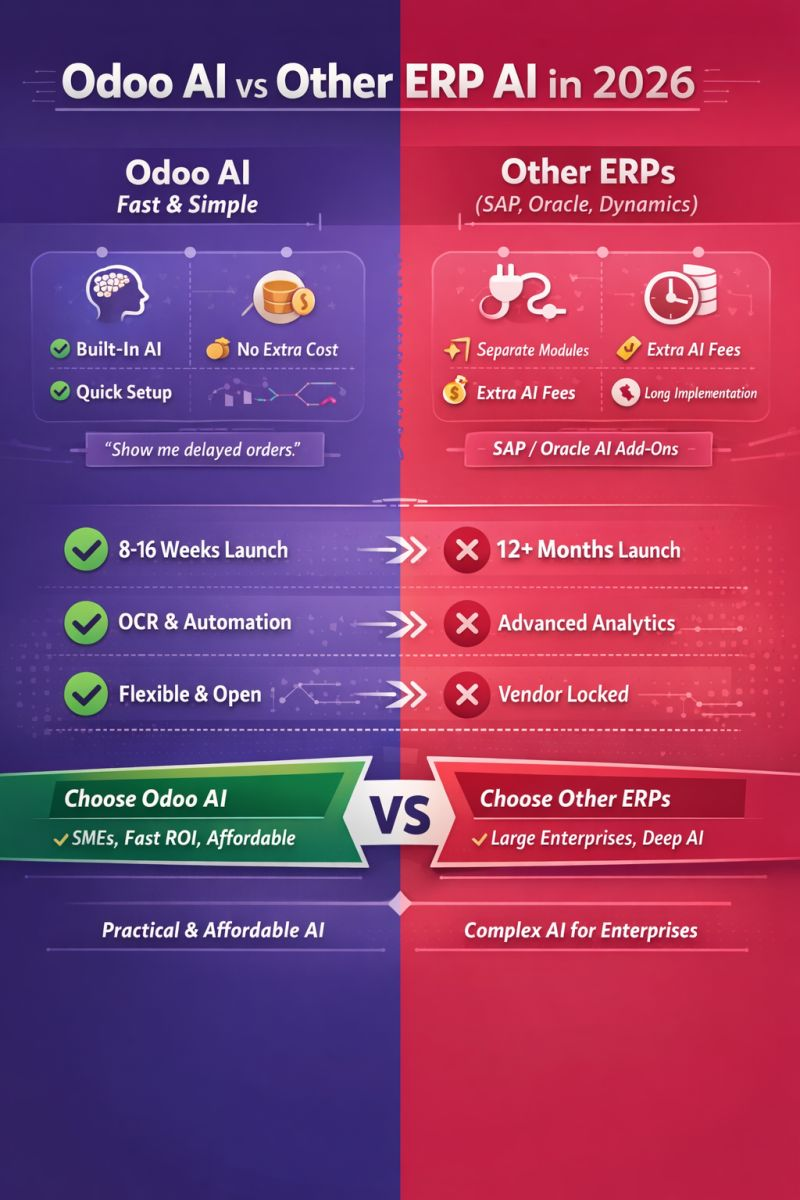
**Odoo AI vs other ERPs (SAP, Oracle, Dynamics, etc.) in 2026** 👇
# 🧠 Odoo AI vs Other ERP AI
## 1) AI Philosophy (Core Difference)
### 🔵 Odoo AI
* **Embedded AI inside workflows**
* Works directly with your ERP data (sales, invoices, inventory)
* Natural language + automation + prediction in one place
* AI is **part of the system, not a separate layer** ([havitechnology.wixsite.com][1])
### 🔴 Other ERPs (SAP, Oracle, Dynamics)
* AI is often:
* Separate modulle
* Add-on service
* Or external integration
* More **enterprise-grade but fragmented**
👉 Example:
* SAP Joule AI = separate pricing + setup
* Oracle AI = powerful but complex integration
✅ **Winner:** Odoo (simplicity & usability)
## 2) Cost of AI 💰
### 🔵 Odoo AI
* Included in license (no extra AI cost) ([Braincuber Technologies][2])
* Predictable pricing
* Ideal for SMEs & scaling companies
### 🔴 Other ERPs
* AI priced separately (usage-based or premium)
* Example:
* SAP AI → paid per “AI unit” ([Braincuber Technologies][2])
* Extra cloud compute costs
✅ **Winner:** Odoo (by far)
## 3) Implementation Speed 🚀
### 🔵 Odoo AI
* Go-live: **8–16 weeks**
* AI works immediately once system is live ([Braincuber Technologies][2])
### 🔴 Other ERPs
* Implementation: **6–18 months**
* AI comes later (phase 2 or 3)
✅ **Winner:** Odoo
## 4) AI Capabilities ⚙️
### 🔵 Odoo AI (Practical AI)
* Document OCR (invoices, receipts)
* Predictive sales & inventory
* AI-generated emails/content
* Smart recommendations
* Natural language queries
* Workflow automation
👉 Focus: **daily business productivity**
### 🔴 Other ERPs (Advanced AI)
* Deep analytics & enterprise forecasting
* Industry-specific AI (manufacturing, finance)
* Complex ML models
* Big data processing
👉 Focus: **large-scale enterprise intelligence**
✅ **Winner depends:**
* SME → Odoo
* Enterprise → SAP/Oracle
## 5) Flexibility & Custom AI 🔧
### 🔵 Odoo
* Open architecture
* Can integrate:
* ChatGPT / LLMs
* Custom AI models
* Modular → easy to extend
### 🔴 Other ERPs
* Strong but:
* Vendor-locked
* Expensive customization
* Slower innovation cycles
✅ **Winner:** Odoo (flexibility)
## 6) AI Strategy (Big Picture)
### 🔵 Odoo
* “AI for everyone”
* Democratized AI inside ERP
* Focus on usability + speed
### 🔴 Other ERPs
* “AI for enterprise scale”
* Heavy, powerful, but complex
* Focus on governance & depth
# 🏁 Final Verdict
## 🟢 Choose Odoo AI if:
* You want **fast ROI**
* You target **SME / mid-market**
* You need **practical AI in daily operations**
* You care about **cost & flexibility**
## 🔴 Choose Other ERPs if:
* You are a **large enterprise**
* You need:
* Advanced analytics
* Industry-specific AI
* Deep compliance systems
* Budget is not a constraint
# 💡 Simple One-Line Summary
👉 **Odoo AI = Practical, fast, affordable AI for business users**
👉 **Other ERP AI = Powerful, complex AI for large enterprises**
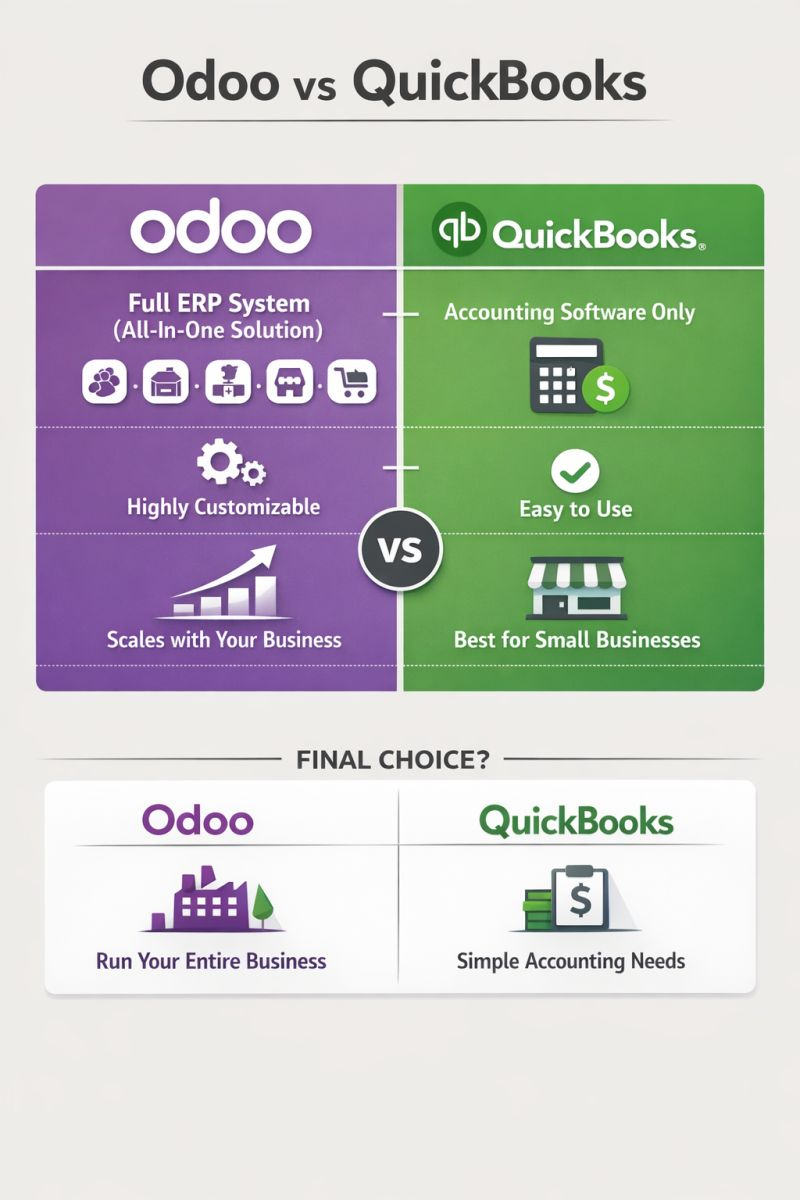
Here’s a **clear, practical comparison** between **Odoo vs QuickBooks 👇
# ⚔️ Odoo vs QuickBooks
## 🧠 Core Difference (Very Important)
* **Odoo** → Full **ERP system** (runs your entire business)
* **QuickBooks** → **Accounting software only**
👉 This single point explains ~80% of the decision.
🧩 1. Scope & Capabilities
🔵 Odoo
* Accounting + CRM + Inventory + HR + Sales + Manufacturing
* All-in-one system (single database)
* Highly customizable (open-source)
🟢 QuickBooks
* Focus on:
* Accounting
* Invoicing
* Expenses
* Payroll (add-on)
* Needs integrations for everything else
✅ **Winner:** Odoo (for business operations)
✅ **Winner:** QuickBooks (for pure accounting simplicity)
⚙️ 2. Features Comparison
| Feature | Odoo | QuickBooks |
| ------------- | ---------- | ----------------- |
| Accounting | ✅ Advanced | ✅ Strong |
| CRM | ✅ Built-in | ❌ |
| Inventory | ✅ Advanced | ⚠️ Basic |
| Manufacturing | ✅ Full MRP | ❌ |
| HR | ✅ Included | ⚠️ Limited |
| eCommerce | ✅ Built-in | ❌ |
| Integrations | ✅ Native | ⚠️ External tools |
📌 Odoo replaces **multiple systems**, while QuickBooks usually becomes **one tool among many** ([Ecosire][3])
💰 3. Cost Reality (Important Insight)
QuickBooks
* Lower starting cost
* BUT:
* Add-ons (payroll, CRM, inventory tools)
* Multiple systems = higher total cost
Odoo
* Can start **free (Community)**
* Paid per user (Enterprise)
* Higher initial setup cost
👉 Long-term:
* Odoo is often **cheaper at scale**
* QuickBooks is cheaper **at the beginning**
🚀 4. Scalability
QuickBooks
* Perfect for:
* Freelancers
* Small businesses
* Problem:
* You’ll likely outgrow it
Odoo
* Designed for:
* SMEs → Enterprises
* Scales with operations
📌 Many companies switch when:
* Team > 10 people
* Operations get complex
🧑💻 5. Ease of Use
QuickBooks
* Very easy
* Fast setup
* Minimal training
Odoo
* More complex
* Needs implementation partner (usually)
* Requires business process thinking
💡 Reddit insight:
> “Odoo is all-in-one… instead of stitching multiple tools together”
🏁 Final Verdict (Straight to the Point)
✅ Choose QuickBooks if:
* You only need accounting
* You’re a startup / small business
* You want something quick & simple
✅ Choose Odoo if:
* You want to run your **entire business in one system**
* You have:
* inventory
* sales team
* operations
* You’re thinking long-term growth
🔥 My Honest Advice (Based on Real Market Behavior)
* **Startups in Egypt → QuickBooks mindset**
* **Growing companies → move to Odoo within 1–3 years**
👉 The real question is not:
> “Which is better?”
👉 It’s:
> “Are you still small… or planning to scale?”
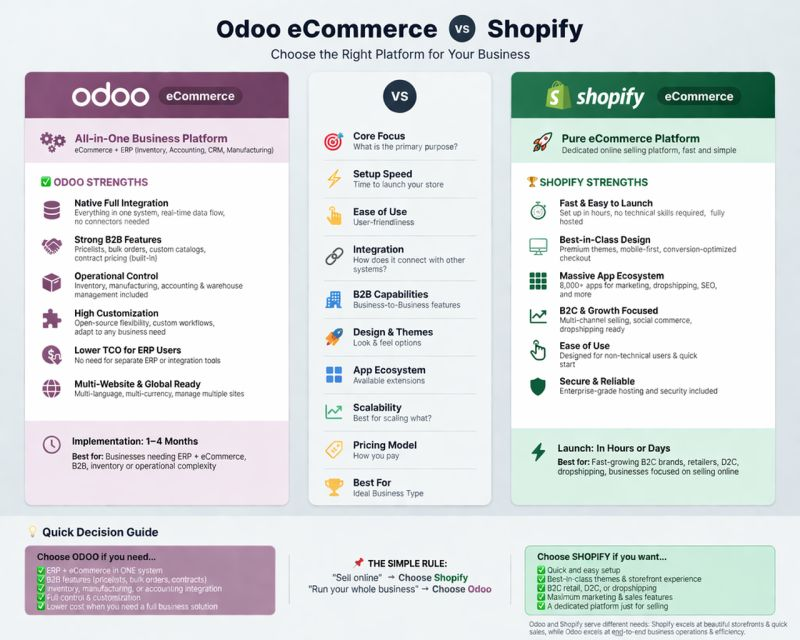
**Odoo eCommerce vs Shopify – Quick Take ⚔️**
Choosing between **Odoo** and **Shopify** isn’t about features… it’s about strategy.
🔹 **Shopify**
Built for selling fast
✔️ Easy to launch
✔️ Best-in-class storefront & UX
✔️ Huge app ecosystem
👉 Ideal for B2C & growth-focused brands
🔹 **Odoo eCommerce**
Built for running your business
✔️ Full ERP integration (Inventory, Accounting, CRM)
✔️ Strong B2B capabilities
✔️ High customization & control
👉 Ideal for companies with operational complexity
🎯 **The Rule:**
* Want to **sell online fast?** → Shopify
* Want to **manage your entire business in one system?** → Odoo
💡 It’s not about which is better…
It’s about what your business actually needs.
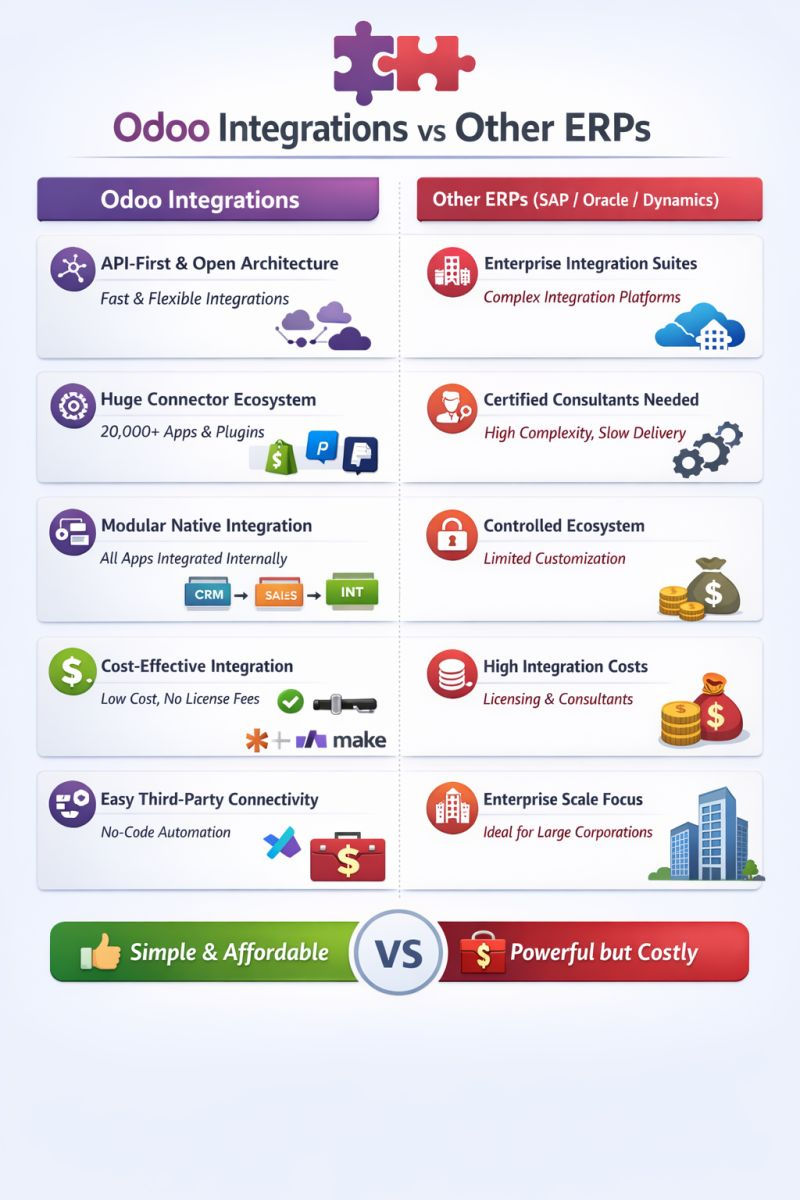
Here’s a **clear, business-oriented comparison** of **Odoo integration strength vs other ERPs (SAP, Oracle, Microsoft Dynamics, etc.)**—perfect for positioning, sales, or infographic content.
🔗 Odoo Integrations vs Other ERPs
🟢 1. Odoo Integration Strength
✅ **1. API-First & Open Architecture**
* REST, XML-RPC, JSON-RPC APIs available
* Full access to business objects (sales, inventory, accounting)
* Easy to build custom integrations without heavy restrictions ([Aenten][1])
👉 Result: **Fast + flexible integrations**
✅ **2. Huge Connector Ecosystem**
* 20,000+ apps/modules in Odoo App Store ([Appvizer][2])
* Ready connectors for:
* eCommerce (Shopify, WooCommerce)
* Payments (Stripe, PayPal)
* Logistics (DHL, FedEx)
* Marketing & CRM tools ([Abbacus Technologies][3])
👉 Result: **Plug & play integrations (low effort)**
✅ **3. Modular Native Integration**
* All Odoo apps are already integrated internally
* CRM ↔ Sales ↔ Inventory ↔ Accounting in one database
👉 Result:
⚡ **No need for external integration inside the system**
✅ **4. Cost-Effective Integration**
* No extra license fees for integrations (open-source advantage)
* Lower dependency on expensive consultants ([odoo.adatasol.com][4])
👉 Result: **Best ROI for SMEs**
✅ **5. Easy Third-Party Connectivity**
* Works with Zapier / Make (no-code automation)
* Fast connection to modern SaaS tools
👉 Result: **Business users can automate without developers**
🔴 Other ERPs (SAP / Oracle / Dynamics)
🔶 **1. Enterprise-Grade Integration Platforms**
* SAP Integration Suite
* Oracle Integration Cloud
👉 Result:
💪 **Very powerful for large-scale environments**
🔶 **2. Structured but Complex**
* Requires:
* Certified consultants
* Middleware (ESB, iPaaS)
* Longer implementation cycles ([Dasolo][5])
👉 Result:
⚠️ **High complexity + slower delivery**
🔶 **3. Strong Ecosystem (But Controlled)**
* Deep integration inside vendor ecosystem
* Less flexible outside (custom integrations harder)
👉 Result:
🔒 **Best inside their own stack**
🔶 **4. High Cost of Integration**
* Licensing + consulting + maintenance
* Integration becomes a **project on its own**
👉 Result:
💰 **Expensive (especially for SMEs)**
🔶 **5. Better for High-Volume / Enterprise Scenarios**
* Handles:
* Massive transactions
* Complex compliance
* Multi-country governance
👉 Result:
🏢 **Ideal for large enterprises**
# 🎯 Key Takeaway
* **Odoo wins in:**
* Flexibility
* Speed
* Cost
* Ease of integration
* **Other ERPs win in:**
* Enterprise-grade governance
* Massive scale integrations
* Standardization
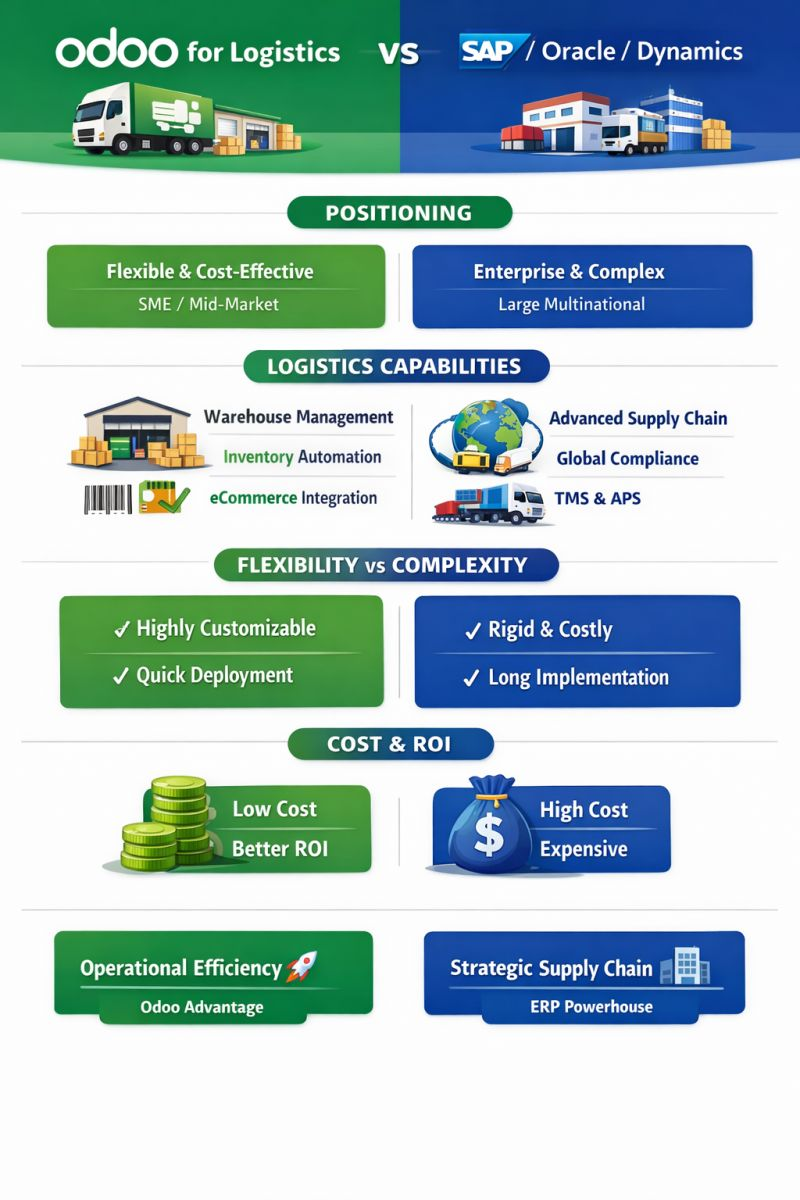
Here’s a **clear, business-focused comparison of Odoo for logistics vs other major ERPs** (like SAP, Oracle, Microsoft Dynamics), tailored specifically for **logistics & supply chain operations**.
# 🚚 Odoo for Logistics vs Other ERPs
🧩 1. Core Positioning
👉 Key takeaway:
* **Odoo = agility & cost efficiency**
* **Others = depth & enterprise complexity**
📦 2. Logistics & Supply Chain Capabilities
## 🟢 Odoo Logistics Strengths
* Warehouse management (multi-warehouse, routes, rules)
* Inventory automation (reordering rules, forecasting)
* Delivery integrations (DHL, FedEx, UPS)
* Barcode & real-time stock tracking
* Easy integration with eCommerce & POS
➡️ Strong for **operational logistics + fast deployment**
📌 Odoo supports:
* Multi-warehouse structures
* Automated order-to-delivery workflows ([SoftwareSuggest][1])
🔵 SAP / Oracle / Dynamics Strengths
* Advanced supply chain planning (APS)
* Global trade compliance & customs
* Transportation Management Systems (TMS)
* AI-driven demand forecasting
* Complex multi-country operations
➡️ Designed for:
* Large-scale logistics networks
* Highly regulated industries
📌 SAP especially excels in **large-scale supply chain orchestration & planning**
⚙️ 3. Flexibility & Customization
👉 Odoo advantage:
* 10,000+ apps ecosystem
* Easy to tailor for logistics niche needs ([purshoLOGY – Rent. Use. Succeed.][3])
💰 4. Cost & ROI
👉 Real-world pattern:
* SMEs often **overpay for SAP/Oracle**
* Odoo gives **better ROI for mid-sized logistics companies**
👉 Odoo wins in:
* User adoption
* Faster onboarding
🏢 5. Best Fit by Logistics Business Type
✅ Choose Odoo if:
* 3PL / distribution company
* SME or mid-sized logistics firm
* Need **quick deployment + flexibility**
* Budget-sensitive
✅ Choose SAP / Oracle if:
* Large enterprise / multinational
* Complex global supply chain
* Heavy compliance & planning needs
* Advanced TMS / APS required
⚖️ Final Verdict (Logistics Perspective)
🟢 Odoo Wins In:
* Flexibility & customization
* Cost efficiency
* Speed of implementation
* SME logistics operations
🔵 Traditional ERPs Win In:
* Deep supply chain planning
* Enterprise-scale logistics
* Complex global operations
# 🎯 Simple Summary
* **Odoo = “Operational Efficiency Engine” 🚀**
* **SAP / Oracle = “Strategic Supply Chain Powerhouse” 🏗️**
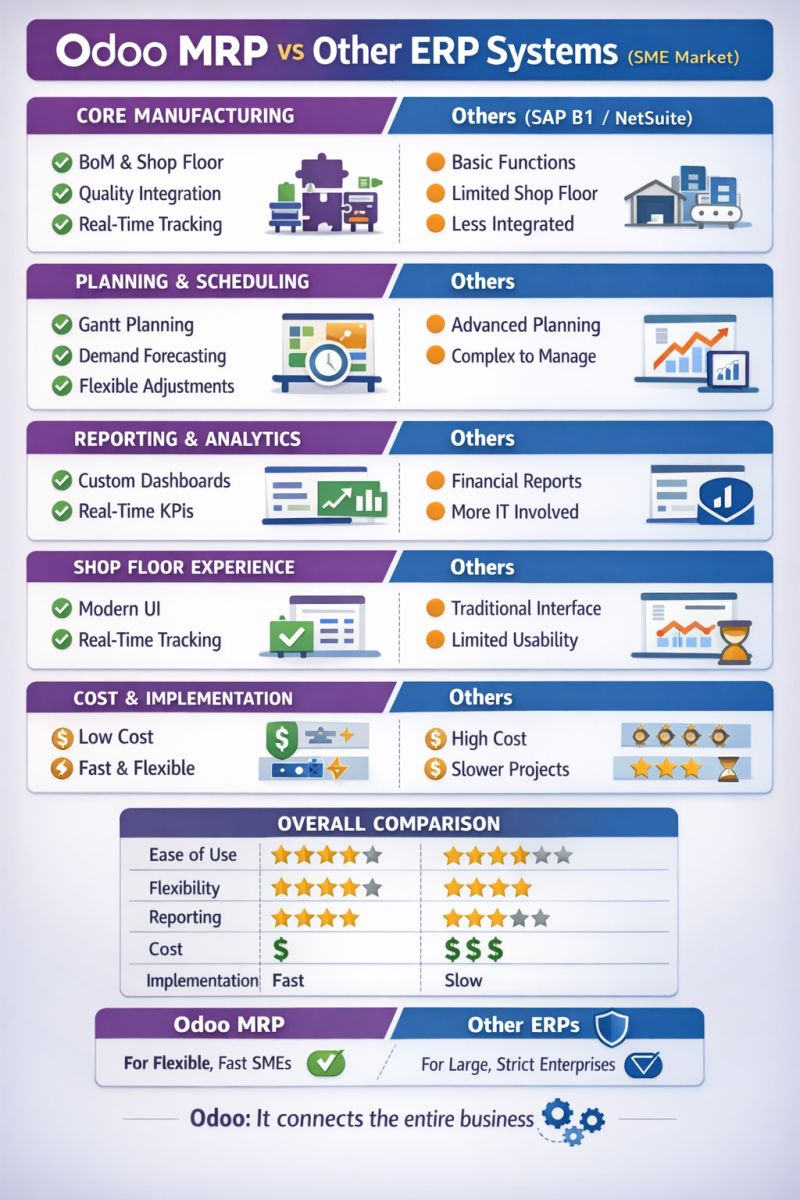
# 🏭 Odoo Manufacturing (MRP) vs Other ERP Systems (SME Market)
⚙️ CORE MANUFACTURING
**Odoo MRP**
✔ BoM (Multi-level)
✔ Work Orders & Routings
✔ Shop Floor Control
✔ Quality + Maintenance Integration
✔ Real-time tracking
**Others (SAP B1 / NetSuite / Dynamics)**
➖ Strong basics
➖ Limited shop floor (often needs add-ons)
➖ Less integrated modules
📅 PLANNING & SCHEDULING
**Odoo**
✔ Gantt Planning
✔ MPS & Forecasting
✔ Flexible capacity planning
✔ Easy adjustments
**Others**
✔ Advanced planning
➖ More complex to manage
➖ Requires expertise
📊 REPORTING & ANALYTICS
**Odoo**
✔ Custom dashboards
✔ Pivot tables (user-friendly)
✔ Real-time KPIs (OEE, Costs)
✔ No IT dependency
**Others**
✔ Strong financial reports
➖ Less flexible for users
➖ More IT involvement
🏭 SHOP FLOOR EXPERIENCE
**Odoo**
✔ Modern UI
✔ Barcode & tablet-friendly
✔ Real-time operator tracking
**Others**
➖ Traditional interfaces
➖ Limited real-time usability
💰 COST & IMPLEMENTATION
**Odoo**
💲 Low Cost
⚡ Fast Implementation
🔧 High Flexibility
**Others**
💲💲💲 High Cost
⏳ Longer Projects
🔒 More rigid
🎯 FINAL INSIGHT
🟢 Odoo MRP
**Best for SMEs needing flexibility, speed, and integration**
🔵 Other ERPs
**Best for large enterprises needing strict control & compliance**
💡 KEY MESSAGE
👉 *Odoo doesn’t just manage manufacturing…*
### **It connects the entire business in one system**
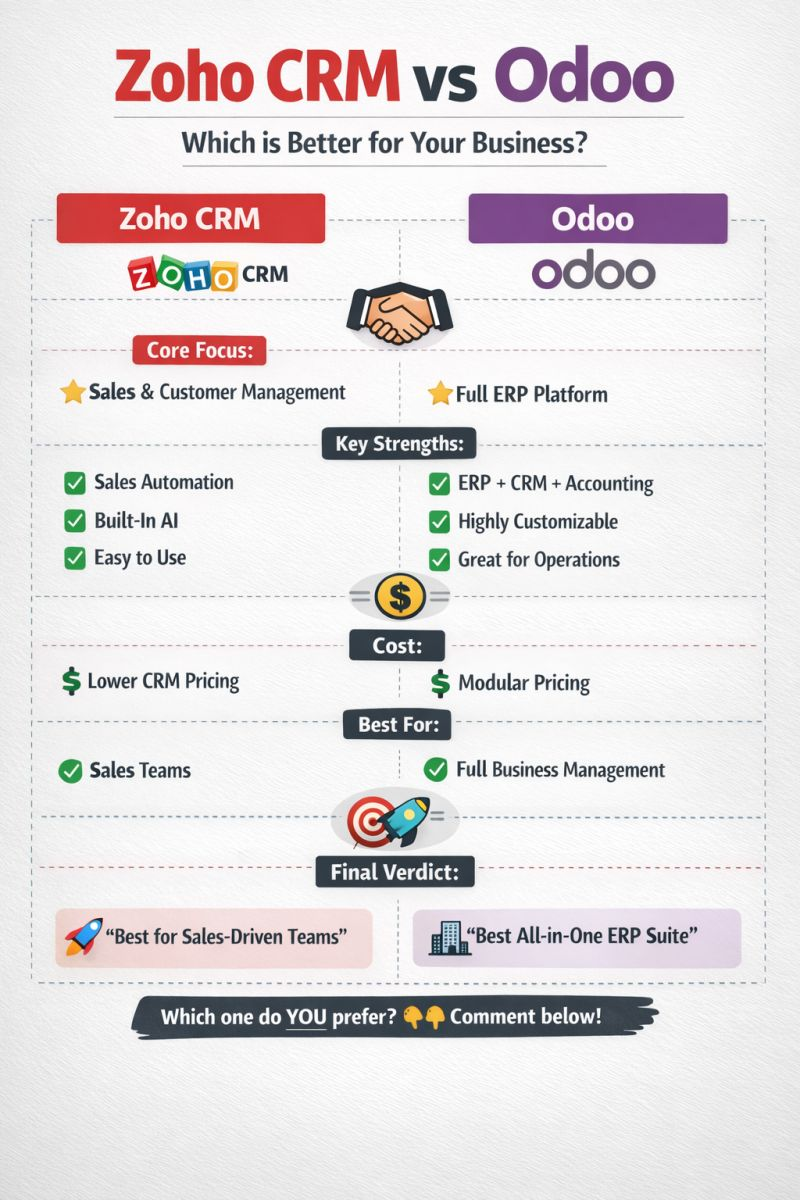
Businesses often ask me:
“Which is better — Zoho CRM or Odoo?”
Here’s a practical comparison so you can decide without confusion 👇
🧠 1. Core Purpose
🔹 Zoho CRM — CRM-first platform focused on sales, pipeline & customer engagement
🔹 Odoo — Full ERP system with CRM as one of many apps
📌 In simple terms:
👉 Zoho CRM = Sales engine
👉 Odoo = Entire business suite
🚀 2. Key Strengths
✅ Zoho CRM
• Best-in-class CRM workflows
• Strong sales automation
• Great for mid-sized sales teams
• Easy to adopt & scale sales focus
• Built-in AI insights
✅ Odoo
• One platform for ERP + CRM + Accounting + HR + Inventory
• Modular — only pay for what you use
• Strong for manufacturing, retail, and operations-heavy businesses
💸 3. Cost Comparison
💰 Zoho CRM
• Predictable pricing tiers
• Lower entry cost for pure CRM use
💰 Odoo
• Modular billing — CRM alone might be cheaper, but full ERP can add up
• Best value if you need multiple modules
👉 If you only need CRM — Zoho is usually cheaper and faster to deploy.
⚙️ 4. Customization & Integrations
🛠 Zoho CRM
• Excellent with Zoho apps (Campaigns, Desk, Analytics)
• Good marketplace integrations
🛠 Odoo
• Extremely customizable
• Integrates across all ERP functions seamlessly
• Great for complex workflows
📊 5. Best Fit Scenarios
✔ Use Zoho CRM if:
• Your focus is sales & pipelines
• Small–mid sales teams
• You want quick implementation
✔ Use Odoo if:
• You want end-to-end business processes
• You need ERP + CRM + Accounts + Inventory in one place
• You’re okay with a slightly steeper learning curve
🧠 Final Take
✨ Zoho CRM = Best CRM tool for sales-centric businesses
✨ Odoo = Best all-in-one platform if you need beyond CRM
Neither is “one-size-fits-all” — it’s about what your business needs today vs future scale.
👇 Which one are you using? Drop a comment — let’s discuss!
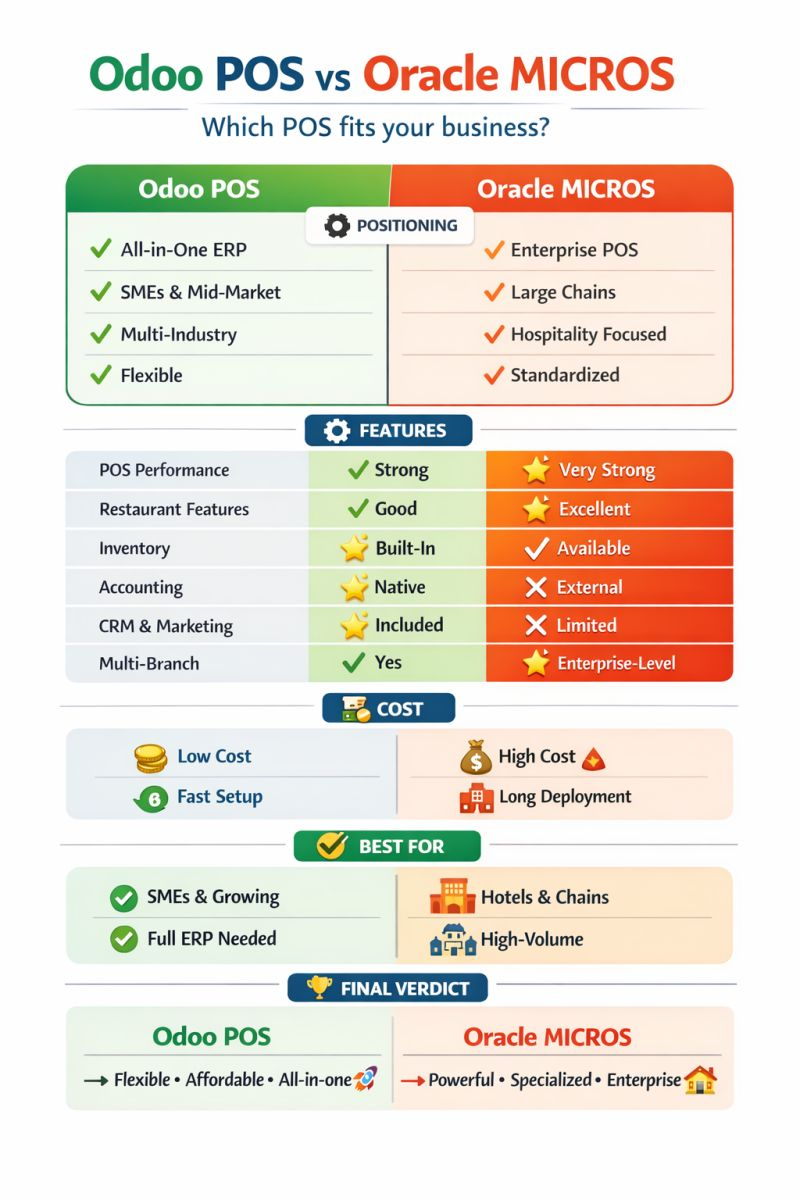
**Odoo POS vs Oracle MICROS** — clean, professional, and perfect for a single-slide post
### Which POS system fits your business?
1️⃣ Positioning
**Odoo POS**
* All-in-one ERP with POS
* Best for SMEs & growing businesses
* Flexible & customizable
* Retail + Restaurants + Services
*Oracle MICROS**
* Enterprise POS platform
* Built mainly for hospitality
* Best for hotel & restaurant chains
* Industry-standard enterprise solution
2️⃣ Feature Comparison (See figure below)
3️⃣ Cost Comparison
**Odoo POS**
* Low license cost
* Fast implementation
* Lower total cost
* Ideal for SMEs
*Oracle MICROS**
* Expensive enterprise pricing
* Long implementation cycle
* High total investment
* Designed for large chains
4️⃣ Best Choice For
**Choose Odoo POS if:**
* You want one system for everything (ERP + POS)
* You are a small or mid-size business
* You want flexibility & fast deployment
* Budget matters
**Choose Oracle MICROS if:**
* You run a hotel or large restaurant chain
* You need enterprise-level hospitality features
* You have many branches
* Budget is not the main concern
5️⃣ Final Verdict
**Odoo POS = Smart, flexible, and cost-effective 🚀**
**Oracle MICROS = Powerful, enterprise hospitality solution 🏨**
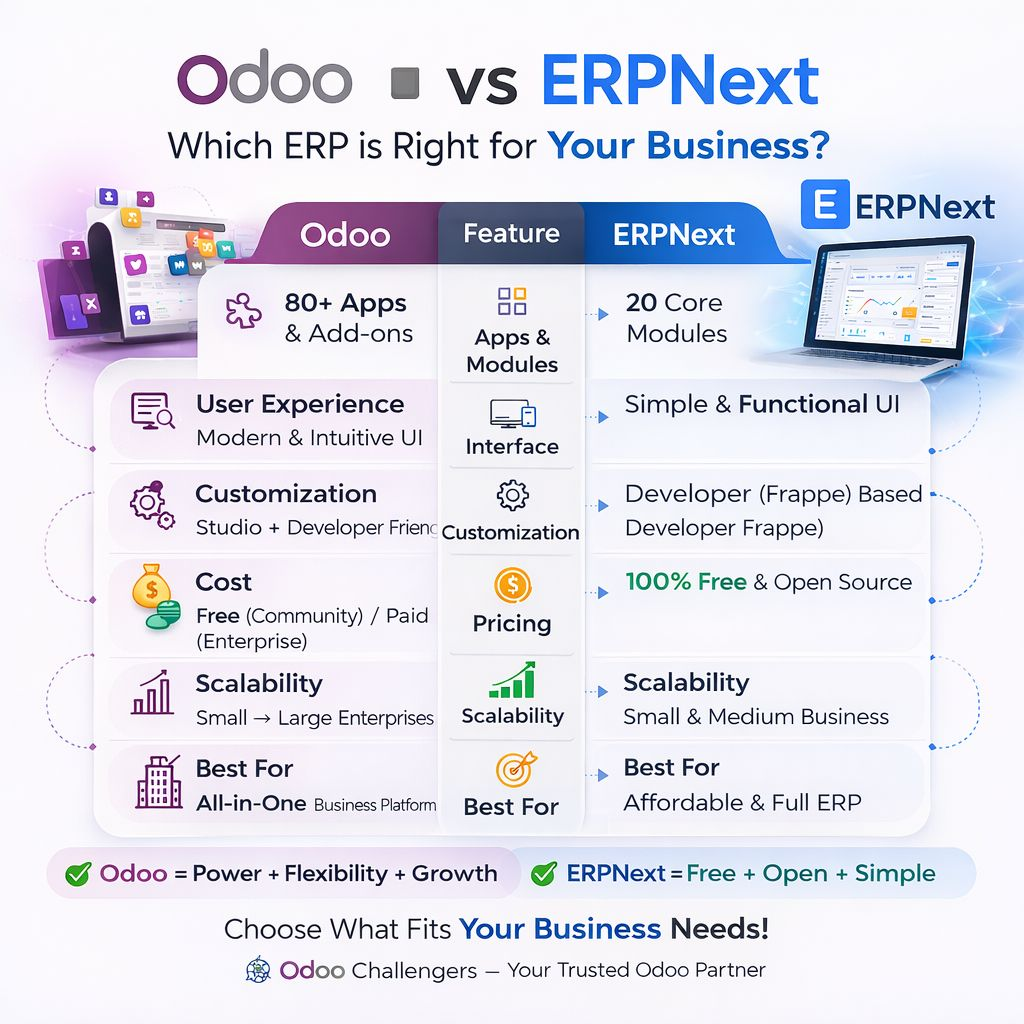
📌 The comparison between Odoo and ERPNext is very important because both are open-source ERP systems, but each follows a different philosophy.
📌 Here’s a clear and quick comparison (especially useful if you work in the ERP field, like your company).
Key Real Differences
1️⃣ Ecosystem
- Odoo has a massive App Store (tens of thousands of applications).
- ERPNext has far fewer add-ons.
➡️ Therefore, Odoo is more suitable when you need:
- POS
- Website
- Marketing Automation
- E-commerce
- Extensive integrations
2️⃣ User Experience
- Odoo has a modern, user-friendly interface for non-technical users.
- ERPNext has a simpler interface, closer to traditional administrative tools.
3️⃣ Cost
- ERPNext is completely free (all modules included).
- Odoo Enterprise requires a subscription per user.
➡️ That’s why many small businesses choose ERPNext due to its lower cost.
4️⃣ Scalability
-
Odoo is better for:
- Medium and large companies
- Complex operations
- Extensive integrations
-
ERPNext is excellent for:
- Small to medium businesses
- Simple operations
- Companies that want fully open-source solutions
Practical Example
A small manufacturing company
➡️ ERPNext may be sufficient.
A business with trading + POS + E-commerce + CRM + Marketing
➡️ Odoo is often the better choice.
Expert Summary
- Odoo = Ecosystem + Scalability + UX
- ERPNext = True Open Source + Lower Cost
✅ Professional Advice:
If a company wants a simple and affordable ERP → ERPNext
If a company wants a complete business platform that scales with growth → Odoo
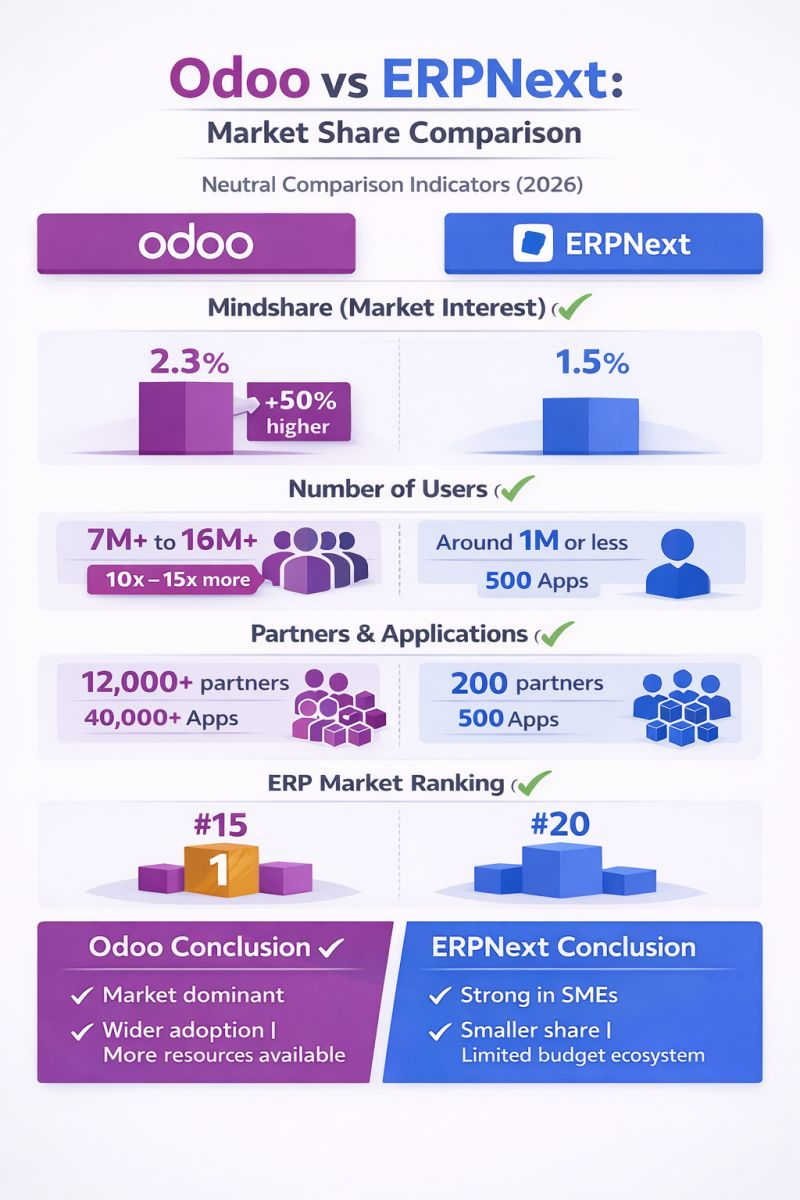
From a **market share perspective**, the gap between **Odoo** and **ERPNext** is quite **clear** — and this is very important when evaluating **adoption and ecosystem strength**.
📊 Market Share Comparison (2026)
1️⃣ Mindshare (User Interest / Market Visibility)
* **Odoo:**around%** → **around 2.3%**
* **ERPNext:** around *%** → **around 1.5%**
👉 This means Odoo is ahead by roughly **50%+ in relative market attention**
2️⃣ User Base
* **Odoo:** **7 million to 16+ million users worldwide**
* **ERPNext:** **around 1 million users or أقل (or less)**
👉 A massive gap (**Odoo is ~10x to 15x larger**)
3️⃣ Ecosystem & Partners (Key Market Indicator)
* **Odoo:**
* Thousands of partners (**3,000+ to 12,000+ depending on the source**)
* **40,000+ apps**
* **ERPNext:**
* ~**200 partners**
* ~**500 apps only**
👉 This shows that Odoo is not just more widely used… it **dominates the ecosystem**
4️⃣ Market Position Ranking
* **Odoo:** around **#15 in the ERP market**
* **ERPNext:** around **#20**
👉 Neither is top-tier like SAP or Oracle, but:
* Odoo is competing more strongly
* ERPNext is still more niche
🎯 Conclusion (Business Insight)
🟢 Odoo
* A leader in open-source ERP
* Strong global presence
* Ideal for companies looking for **scale + ecosystem + partner network**
🔵 ERPNext
* A smaller player
* More limited adoption
* Better suited for **SMEs / budget-conscious companies**
⚖️ Final Verdict (Market Share Perspective)
If we’re talking **pure market dominance:**
👉 **Odoo clearly wins**
* More users
* More partners
* Higher mindshare
* Broader ecosystem
As for ERPNext:
👉 A **strong niche player**, but not a mass-market leader
💡 **Key Insight (especially if you're working with Odoo):**
The difference in market share isn’t just numbers — it translates into:
* More sales opportunities
* Greater resource availability
* Lower risk for customers
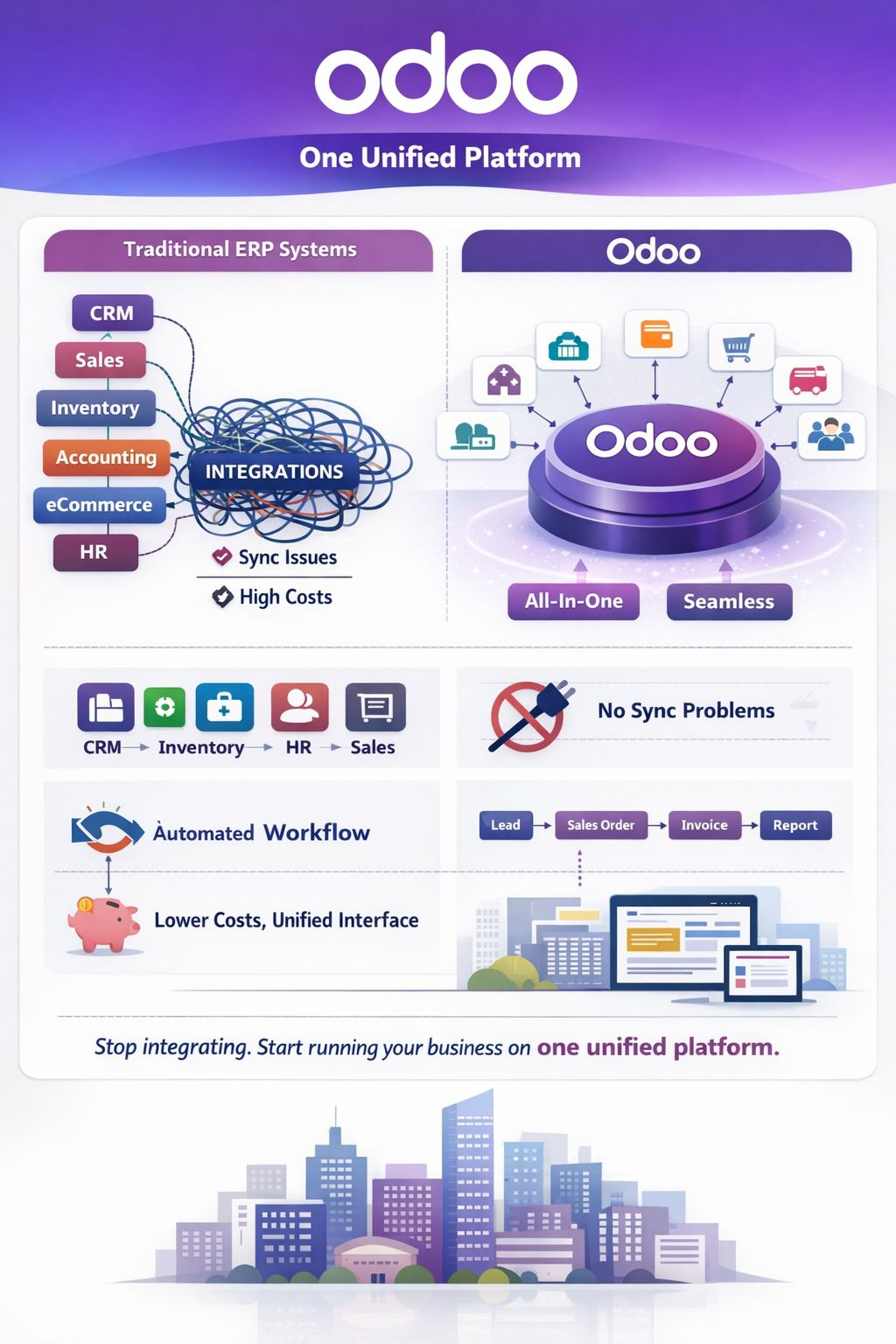
📌Stop integrating multiple systems.
Start running your business on one unified platform with Odoo.
Odoo vs Traditional ERP Systems
One Unified Platform Instead of Multiple Integration Points
Traditional ERP Systems
Different business functions run on separate systems:
CRM
Sales
Inventory
Accounting
eCommerce
HR
These systems require multiple integrations, which often lead to:
❌ Data synchronization issues
❌ Complex system architecture
❌ Higher implementation costs
❌ Difficult maintenance
Odoo
With Odoo everything runs on one integrated platform.
Key Benefits
✔ All-in-One Platform
CRM, Sales, Accounting, Inventory, HR, Website, and more in one system.
✔ Seamless Integration
All applications share the same database.
✔ No Sync Problems
Data flows automatically between departments.
✔ Automated Workflow
Lead
➡ Sales Order
➡ Invoice
➡ Reports
✔ Lower Costs
No need for multiple software licenses or integration tools.
✔ Unified User Experience
Same interface for all departments.

⭕ Comparison between Odoo ERP and Tailored ERP (custom-built specifically for you)
1️⃣ Implementation Time
Odoo ERP
- A ready-made system with hundreds of applications
- Can be up and running within weeks or a few months
Tailored ERP
- Built from scratch
- May take 6 months to 2 years
✅ Winner: Odoo
2️⃣ Cost
Odoo ERP
- You pay for licensing + implementation
- Lower cost because it’s a ready-made system
Tailored ERP
- You pay for analysis + design + development + testing
- Usually much more expensive
✅ Winner: Odoo
3️⃣ Flexibility
Odoo ERP
- Can be customized بسهولة (easily)
- But still within the system’s framework
Tailored ERP
- You can build literally anything
- Complete freedom in design
✅ Winner: Tailored ERP
4️⃣ Risk
Odoo ERP
- Used by thousands of companies worldwide
- Lower risk because it is proven
Tailored ERP
- Fully depends on the development team
- Higher risk of failure or discontinuation
✅ Winner: Odoo
5️⃣ Future Development
Odoo ERP
- Annual updates from Odoo S.A.
- Continuous new features
Tailored ERP
- Every new feature must be paid for separately
✅ Winner: Odoo
Summary
| Factor | Odoo | Tailored ERP |
| Speed | ⭐⭐⭐⭐⭐ | ⭐ |
| Cost | ⭐⭐⭐⭐ | ⭐ |
| Flexibility | ⭐⭐⭐ | ⭐⭐⭐⭐⭐ |
| Risk | ⭐⭐⭐⭐ | ⭐⭐ |
| Updates | ⭐⭐⭐⭐⭐ | ⭐⭐ |
👉 General Rule:
- 80% of companies are best suited for Odoo ERP
- Only 20% truly need a Tailored ERP system
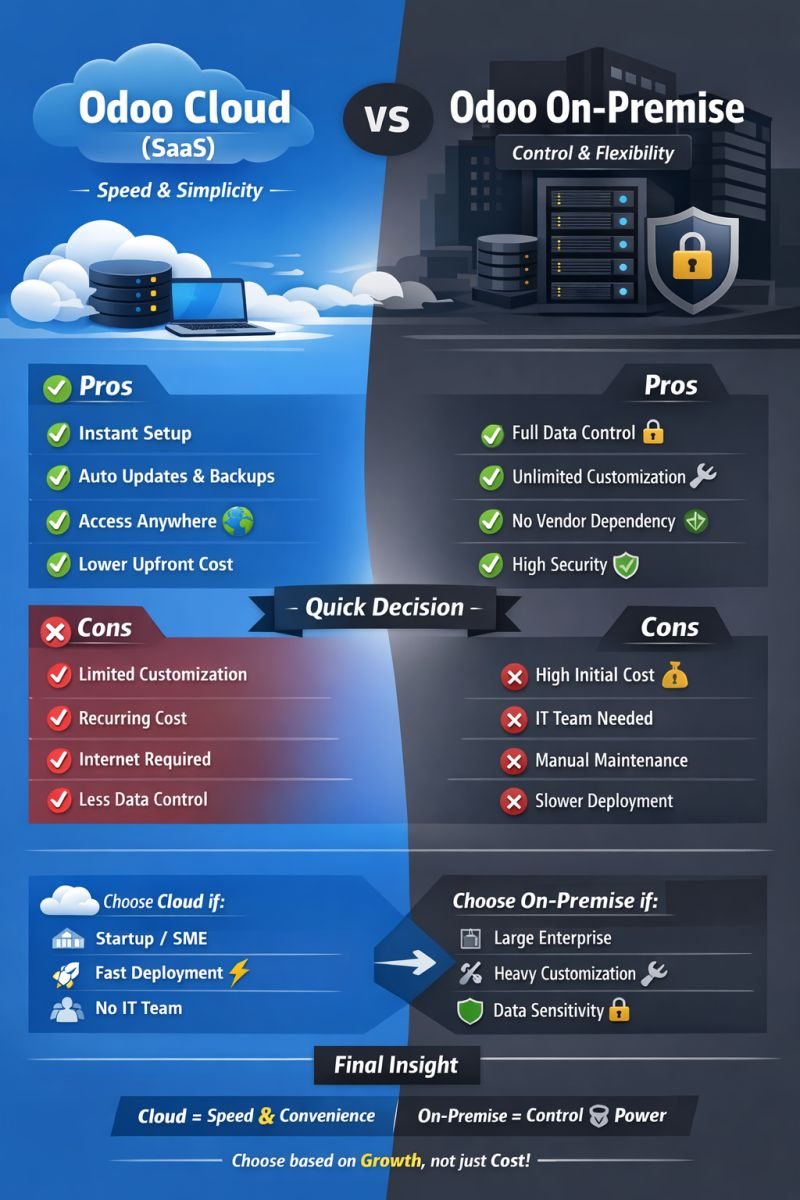
**Odoo Cloud vs Odoo On-Premise** 👇
# 🚀 Odoo Cloud vs On-Premise
### (LinkedIn Infographic Content)
## ☁️ Odoo Cloud (SaaS / Odoo Online)
### ✅ Pros
* **No Infrastructure Needed** → Ready to use instantly
* **Automatic Updates & Backups** → Fully managed by Odoo
* **Lower Upfront Cost** → Subscription-based model ([DevIntelle Consulting Service Pvt Ltd][1])
* **Accessible Anywhere** → Ideal for remote teams
* **Built-in Security** → Managed by provider
### ❌ Cons
* **Limited Customization** → Restricted backend access
* **Ongoing Subscription Costs** → Increases with scale
* **Internet Dependency** → Requires stable connection
* **Less Control Over Data & Servers**
## 🏢 Odoo On-Premise (Self-Hosted)
### ✅ Pros
* **Full Control** → Data, servers, and infrastructure
* **Unlimited Customization** → Access to full source code
* **Better for Compliance** → Ideal for regulated industries
* **Long-Term Cost Efficiency** (for large companies)
* **No Vendor Dependency**
### ❌ Cons
* **High Initial Cost** → Hardware + setup
* **Requires IT Team** → Maintenance, backups, security
* **Longer Implementation Time**
* **Limited Remote Accessibility** (unless configured)
## ⚖️ Quick Comparison
| Factor | ☁️ Cloud | 🏢 On-Premise |
| ------------- | --------------- | ------------------- |
| Setup Time | Fast ⚡ | Slow ⏳ |
| Cost Model | Subscription 💳 | CapEx 💰 |
| Customization | Limited | Unlimited 🔧 |
| Maintenance | Odoo Managed | Your Responsibility |
| Scalability | Easy | Manual |
| Data Control | Medium | Full 🔐 |
## 🎯 When to Choose What?
👉 **Choose Odoo Cloud if:**
* You want **fast go-live**
* No internal IT team
* Standard processes
* Focus on **business, not infrastructure**
👉 **Choose On-Premise if:**
* You need **heavy customization**
* لديك **متطلبات أمان أو Compliance عالية**
* عندك **IT Team قوي**
* تريد **تحكم كامل في البيانات**
## 💡 Pro Insight
> “Cloud is about speed and simplicity…
> On-Premise is about control and power.
> The right choice depends on your business maturity.”
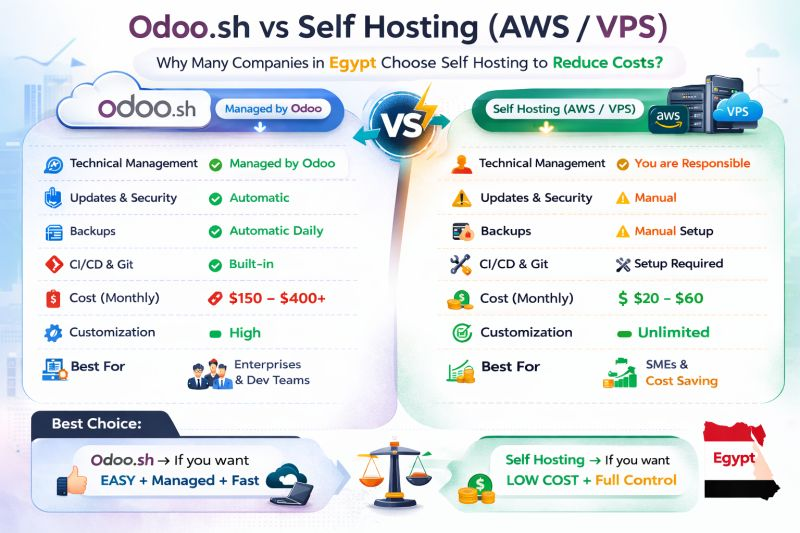
Here’s a clear and professional English translation of your article:
⭕ Why do many companies in Egypt choose self-hosting for Odoo instead of Odoo.sh?
Comparing Odoo.sh with Self Hosting on Amazon Web Services (AWS) or VPS is very important, as many companies in Egypt prefer self-hosting to reduce costs.
Let me give you the practical, real-world perspective used by many Odoo partners 👇
Odoo.sh vs Self Hosting (AWS / VPS)
| Aspect | Odoo.sh | Self Hosting (AWS / VPS) |
| Technical Management | Managed by Odoo | Fully your responsibility |
| Updates | Very easy | Requires DevOps |
| Backups | Automatic | Must be set up manually |
| CI/CD | Built-in | Requires setup |
| Full Control | Limited | Full control |
| Cost | Higher | Much lower |
⭐ When should you choose Odoo.sh?
Choose it when:
1️⃣ You have a development team
Because Odoo.sh provides:
- Git integration
- Staging environments
- Automatic testing
- Easy deployments
2️⃣ You have a large or enterprise project
For example:
- 50+ users
- Many integrations
- Continuous development
3️⃣ You want to avoid server-related issues
Everything is managed by Odoo:
- Updates
- Security
- Backups
- Monitoring
📌 Therefore, Odoo.sh is ideal for companies that want to focus on business rather than server management.
⭐ When should you choose Self Hosting (AWS / VPS)?
This option is very common in Egypt.
1️⃣ You want to reduce costs
Approximate example:
- Odoo.sh may cost $150–$400/month
- A good VPS may cost only $20–$60/month
A big difference for small businesses.
2️⃣ You have a DevOps engineer or System Administrator
Because you will be responsible for:
- Server management
- Security
- Backups
- Updates
- Performance
3️⃣ You need full control
Self-hosting allows you to:
- Customize the server
- Install any tools
- Run multiple databases
- Optimize performance
The truth many people don’t talk about
Many Odoo partners in Egypt operate like this:
1️⃣ The client purchases an Odoo Enterprise license
2️⃣ The system is self-hosted on VPS or AWS
3️⃣ The server is managed internally or by a partner
📌 Reason:
Reduce costs while maintaining development flexibility.
Quick decision rule
| Situation | Best Choice |
| Small company without IT | Odoo.sh |
| Company seeking lowest cost | Self Hosting |
| Company with DevOps | Self Hosting |
| Large enterprise project | Odoo.sh |
| Startup seeking speed | Odoo.sh |
Here is a clear and professional English translation of your content:
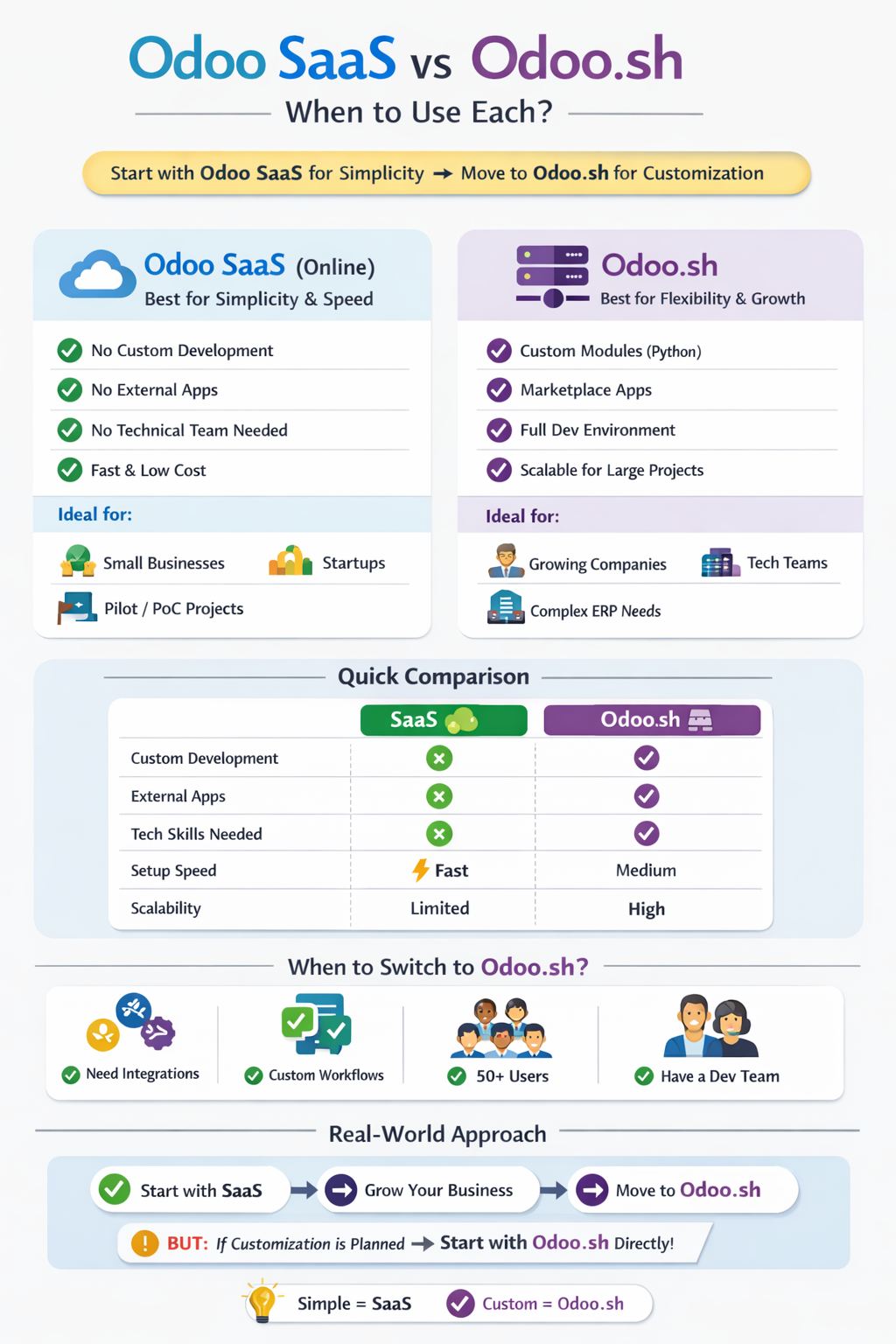
⭕ When should you use Odoo.sh and when should you use Odoo SaaS (Online)?
The simple rule for choosing between Odoo SaaS (Odoo Online) and Odoo.sh is:
Start with SaaS as long as your project is simple, and move to Odoo.sh when your project requires real customization and development.
Let me explain exactly when Odoo.sh becomes the better choice 👇
When to choose Odoo SaaS
Choose it if:
1️⃣ No custom development is needed
- You only use standard Odoo applications
- You don’t need to write Python modules
2️⃣ You don’t need external apps
- SaaS does not allow installing third-party modules from the App Store
3️⃣ You don’t have a technical team
- Everything is managed by Odoo
- No need for DevOps or Git
4️⃣ You want the lowest cost and fastest setup
- SaaS is the cheapest and easiest option for SMEs
📌 Therefore, SaaS is suitable for:
- Small companies
- Startups
- PoC or pilot projects
When Odoo.sh is the better choice
Move to Odoo.sh when any of the following applies:
1️⃣ You need custom modules
For example:
- Integration with external systems
- Company-specific workflows
- Modifying logic in Accounting or Inventory
SaaS does not allow this, while Odoo.sh fully supports module development and installation.
2️⃣ You want to install apps from the Odoo Marketplace
Such as:
- Country-specific localization
- Manufacturing add-ons
- Advanced reporting tools
SaaS does not allow apps that include Python code.
3️⃣ You have a development team
Odoo.sh provides:
- Git integration
- CI/CD
- Staging environments
- Automated testing
It is designed specifically for development projects.
4️⃣ Your project has grown
For example:
- 50+ users
- Complex workflows
- Multiple integrations
Odoo.sh allows better scalability and easier deployment management.
A rule used by most Odoo partners
Use this guideline:
| Scenario | Best Choice |
| Small company with no customization | SaaS |
| Company wanting a quick ready ERP | SaaS |
| Light customization | SaaS |
| Custom modules needed | Odoo.sh |
| Many integrations | Odoo.sh |
| Development team available | Odoo.sh |
My practical advice (very important)
Many companies follow this path:
1️⃣ Start with Odoo SaaS
2️⃣ As the project grows
3️⃣ Move to Odoo.sh
However, if you already know from the beginning that you will need customization,
start directly with Odoo.sh to avoid future migration.
When businesses decide to implement Odoo ERP, they often face a crucial decision: Should they go with an Odoo Official Partner or take the cheaper route and hire a freelancer? While freelancers might seem like an attractive option due to their low pricing, the reality is that cost savings in the short term can lead to massive headaches in the long run. As the saying goes, “If you pay for peanuts, you will get monkeys.”
1. Expertise and Experience
Odoo Official Partners:
Trained and certified by Odoo, ensuring high expertise in implementation, customization, and support.
Have extensive experience with multiple industries and complex business requirements.
Access to official Odoo resources, updates, and direct support from Odoo.
Freelancers:
Lack formal Odoo certification and training.
Often self-taught with limited real-world experience in handling enterprise-level projects.
No access to official Odoo support, meaning troubleshooting can become a nightmare.
2. Reliability and Accountability
Odoo Official Partners:
Work under a legally bound agreement, ensuring commitment to project timelines and deliverables.
Provide a structured implementation approach with clear milestones and quality checks.
Offer post-implementation support and long-term maintenance.
Freelancers:
No accountability – they can disappear anytime, leaving your project unfinished.
Work on multiple projects at once, leading to divided attention and frequent delays.
Lack of proper documentation, making it difficult to scale or hand over the project to another developer.
3. Quality of Work
Odoo Official Partners:
Follow best practices for coding, customization, and implementation.
Ensure smooth integrations with other business tools.
Conduct thorough testing to avoid critical errors and data losses.
Freelancers:
Often use shortcuts and quick fixes that lead to unstable systems.
Poor coding practices result in long-term performance and security issues.
Lack of structured testing, leading to frequent bugs and breakdowns.
4. Support and Maintenance
Odoo Official Partners:
Provide structured post-implementation support.
Offer Service Level Agreements (SLAs) for quick issue resolution.
Can scale up services as your business grows.
Freelancers:
No guarantee of long-term support – once the project is done, they might vanish.
Unreliable and slow response time for bug fixes and updates.
If your freelancer quits or becomes unavailable, you might need to start from scratch with another developer.
5. Security and Data Protection
Odoo Official Partners:
Follow industry standards for data protection and security.
Ensure compliance with local regulations and best practices.
Provide secure hosting and backup solutions.
Freelancers:
No legal responsibility for data security – your sensitive business data could be at risk.
Might use unauthorized third-party modules that compromise security.
No proper backup solutions, leading to potential data loss.
6. Odoo Does Not Support Freelancers or Their Clients
One of the most important factors to consider is that Odoo does not support clients who have implemented Odoo through freelancers. If you run into issues, require bug fixes, or need help from Odoo directly, you will be left stranded. Odoo Official Partners have more stronger access to Odoo’s support team, ensuring smooth issue resolution and proper system functionality. This means that by choosing a freelancer, you risk having an unsupported system with no recourse if problems arise.
Conclusion , Why Choosing an Odoo Official Partner is the Right Decision?
While freelancers might be cheaper, the risks involved far outweigh the savings. A failed ERP implementation can cost a business thousands in lost revenue, downtime, and inefficiencies. Odoo Official Partners bring experience, reliability, security, and long-term support, ensuring your Odoo ERP system works efficiently and grows with your business.